Before
A swatch is described as sustainable without naming the article, scheme, finish or active scan. The project team then has to chase answers after the design direction is already approved.
SUS-F requires before/after framing, savings demo, case cards and split CTA form.
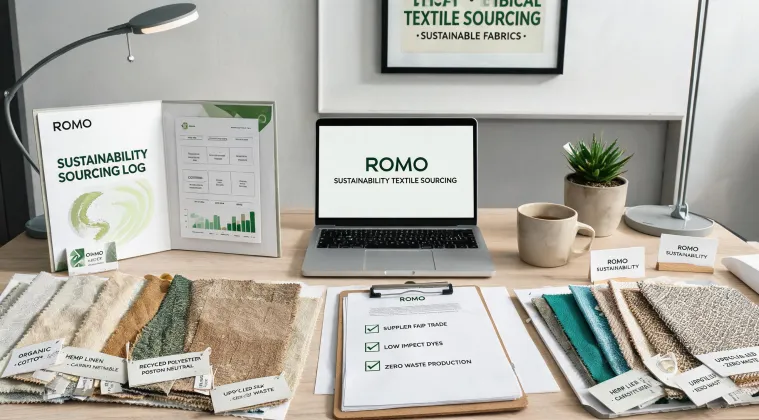
Romo keeps responsible material discussions close to what a contract reviewer can validate: fabric composition, treatment route, memo history, cleaning expectations and current certificate availability. The result is a cleaner handoff between designer enthusiasm and purchasing due diligence.
A swatch is described as sustainable without naming the article, scheme, finish or active scan. The project team then has to chase answers after the design direction is already approved.
The memo record names the fabric family, relevant evidence request, treatment limitations and quote timing so sustainability questions are handled before yardage is reserved.
The team identifies whether a recycled-content claim can be supported for the specific article and what chain-of-custody document should be requested.
Cleaning claims are matched to care expectations, finish limits and room use so maintenance teams can read the recommendation accurately.
Durable upholstery can reduce replacement cycles, but Romo still frames that benefit as a project assumption rather than a universal claim.
The first reply can include memo path, colorway alternatives, documentation notes and quote basis when the request includes project room and decision timing.
For Romo project teams, the useful brief connects design language with procurement evidence. It should name the room type, color family, hand-feel preference, memo sample count, approximate yardage, cleaning expectation, flame-code question, project decision date and whether substitute colorways are acceptable. When those details are present, the trade desk can return a memo path, palette alternatives, documentation notes and quote assumptions in a format that designers, purchasing teams and installation coordinators can read without restarting the conversation.
Each construction is qualified against the published test methods below. Sourcing and QA teams can request the matching certificate during the sample stage.
| Specification | Test Method | Typical Target |
|---|---|---|
| Yarn Count | ASTM D1907 | Ne 30/1 to Ne 80/2 ring-spun shirting; Ne 7-12 OE denim warp |
| Thread Count | ASTM D3775 | 200-800 TC bedding; 60-120 TC towel base |
| GSM | ASTM D3776 | 120-180 g/m² shirting; 320-450 g/m² denim; 400-650 g/m² towel |
| Shrinkage After Wash | AATCC 135 | ≤3% warp/weft 5× home wash; ≤2% hospitality linen |
| Colorfastness Crocking | AATCC 8 | ≥4 dry / ≥3 wet |
| Compliance | OEKO-TEX Standard 100 / GRS / GOTS / BCI | Certificates issued with batch tracing |
Submit a sample request via the inquiry form. Standard memo size 20×20 cm with full technical data sheet (TDS), composition, test method references and lot ID is shipped within 5-10 business days.
An application engineer can be assigned for joint test plans (e.g. Wyzenbeek per ASTM D4157, Martindale per ISO 12947, or MVTR per ASTM E96). Test reports are delivered in ISO/IEC 17025-accredited lab format.
Suppliers receive REACH SVHC declaration, OEKO-TEX or bluesign certificate copies, Higg FEM facility score, and ZDHC ClearStream MRSL conformance summary on request, subject to NDA where applicable.
For specifications where alternative test methods exist (e.g. Wyzenbeek vs Martindale, ASTM E96 vs JIS L1099), a side-by-side method comparison is available so procurement and design teams can align on a single qualifying standard.