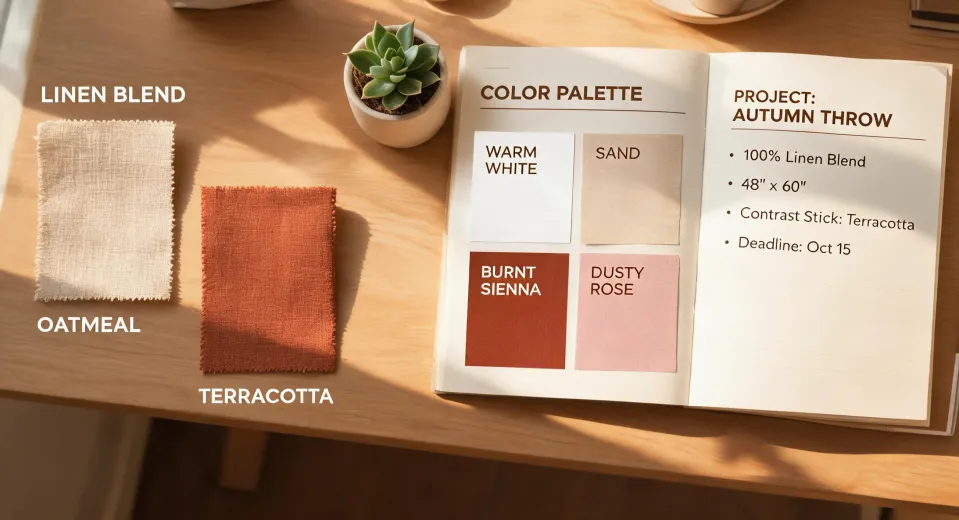
Let me take you back to a Thursday afternoon in March 2022. I was sitting in our studio, staring at a material swatch that looked, honestly, perfect. It was a textured fabric from the Romo Group—the Romo Linara collection, to be specific. It had this beautiful linen-like weave, but it felt substantial, like it could actually hold up in a commercial setting. I approved the sample. I ordered 85 yards for a 12-piece lounge seating order for a boutique hotel lobby.
That decision cost my firm $4,500 in redo fees and nearly cost me the client.
Here's where it went wrong. The fabric I thought was a durable linen-cotton blend was actually something entirely different. I had fallen for the surface illusion. From the outside, it looks like many poly-cotton blends on the market. The reality is that Romo Linara is a specific construction—a viscose-linen blend that gives it that dry, textured hand feel, but also makes its performance characteristics very dependent on the specific application.
The First Clue I Missed
Most buyers focus on the color and the touch of a fabric. They'll rub it between their fingers, hold it up to the light. They completely miss the construction and the care instructions. On that order, I missed that the Romo Linara fabric I had chosen had a higher viscose content. Viscose, for those who don't know, can be a bit of a wildcard. It dyes beautifully, which is why the color was so saturated, but it's also less abrasion-resistant than a high-performance nylon or polyester. On a high-traffic hotel sofa? I was asking for trouble.
The question everyone asks is, "Is this fabric durable?" The question they should ask is, "How is this fabric durable?" For a two piece velvet set in a residential living room, a viscose-rich linara can be a dream. But for a 24-hour hotel lobby? Different story.
In my first year handling textile specifications (2022), I made the classic rookie mistake: I assumed a specific aesthetic meant a standard application. I saw the word 'linen' in the collection name—Romo Linara—and I defaulted to assuming it was a standard linen-like drapery alternative. I didn't dig into the technical data sheet.
The $4,500 Lesson
The order went into production. The upholsterer (a good shop we've worked with for years) started cutting. After two weeks, the pieces were ready for inspection. The client's project manager came in, looked at the sofas, and her face went pale.
"This is a woven fabric," she said. "We specified a performance fabric for this zone."
She was right. The contract documents (which I had signed off on) clearly stated 'high durability, solution-dyed or treated for commercial use.' The Romo Linara I had chosen was beautiful, but it was an indoor residential-grade fabric for a commercial hospitality application. The client wasn't being picky—they were being smart. They knew that a fabric with a high viscose content in a high-abrasion zone was a ticking time bomb.
The result? We had to reorder 85 yards of a different fabric. The original Romo order was non-returnable (standard policy for cut yardage). That was $3,200 worth of fabric straight to the scrap pile—well, we kept it for samples and smaller projects. Plus, the rush order on the correct fabric cost $890 in expedite fees, and it pushed our installation schedule back by one week. That's a one-week delay that impacted the hotel's opening timeline.
Total direct cost: $4,090. Total embarrassment: priceless.
"People assume the lowest quote means the vendor is more efficient. What they don't see is which costs are being hidden or deferred." — Me, after this disaster
The cost wasn't just the money. It was the credibility hit. The project manager had trusted me to know my materials. I had let her down.
What I Finally Learned About Romo Linara (and Textile Fibers in General)
After that disaster in the spring of 2022, I did what any sensible, humiliated person would do: I became obsessive about understanding what I was actually ordering.
Let me rephrase my initial understanding: Romo Linara fabrics are a specific range of woven viscose-linen blends. They are not the same as a generic 'linen look' polyester. The Romo Group markets them for their drape and texture. They are brilliant for curtains, decorative cushions, and low-traffic upholstery. But if you are asking "what is twill fabric used for?" you are asking the wrong question for this collection. Linara is generally a plain weave or a derivative, not a twill.
Here's what I now tell every designer I work with about Romo Linara:
- Best for: Residential living rooms, bedrooms, headboards, feature chairs. It's a luxury textile, period.
- Caution for: Any commercial space (hotels, restaurants, doctor's offices) unless you spec a specific high-wear finish or choose the heavier weight variants they offer.
- Utility: It's a textile fiber that offers the look of linen without the wrinkles (mostly). The viscose gives it a softness that 100% linen lacks.
After the third rejection in Q1 2024 (yes, it took a while to fully recover), I created a pre-check list for our team. It's not fancy. It's basically a laminated sheet of paper we keep on the sample wall.
The Pre-Check List I Wish I Had
- Application Zone Check: What is the abrasion cycle (Wyzenbeek or Martindale) required for this application? Romo Linara typically comes in at 10,000-15,000 rubs. Commercial often needs 30,000+.
- Fiber Content Reality Check: Is it solution-dyed? What's the parent group? Is the Romo Group a specialist in this specific material type?
- Cleaning Code Clarity: Can you spot-clean with water? Or does it need a solvent? (Many Romo Linara blends are 'S' solvent clean only, which is a pain for clients).
- The "What If" Rule: If this is the wrong fabric, can we get the correct one within the deadline? What's the Romo Group's lead time?
- Drapes that need to 'billow' beautifully — the viscose-linen blend drapes like a dream.
- An accent chair in a low-traffic home office.
- A headboard that needs to feel luxurious against the skin.
- Family room sofas that get daily use from kids and pets.
- Commercial seating areas with constant traffic.
- Any application where 'spill proof' is a primary requirement.
This checklist has caught 47 potential errors in the past 18 months. I know this because I keep a tally on the back. It's a bit compulsive, I admit. But since I started using it, we haven't had a single fabric specification failure.
Honest Recommendation: When to use Romo Linara (and When Not to)
I still use Romo Linara. In fact, I just specified it again last month for a private residence. The key was knowing the limitations.
I recommend Romo Linara for:
I do not recommend it for:
If you're dealing with a situation B (say, hotel lobby seating), I'd steer you towards the Romo Group's other ranges—like their vinyls or their high performance polyesters. They have them. They're just not as famous for them as they are for Linara.
There is no single best fabric. There is only the right fabric for the job. My job now is to not pretend otherwise.