-
Step 1: Verify the Product Line and Collection Name
-
Step 2: Know the Weave Structure and Fiber Content
-
Step 3: Order a Physical Sample. Always.
-
Step 4: Match Your Needle and Thread to the Fabric
-
Step 5: Check Dye Lot and Batch Numbers
-
Step 6: Add Waste Factor to Your Yardage
-
Step 7: Confirm Lead Times in Writing
-
The Mistakes I Still See
I'm the office administrator for a 12-person interior design studio. I manage all our fabric, wallcovering, and trim ordering—roughly $400,000 annually across 8 vendors. I report to both operations and finance, which means I'm the one accountable when an order goes wrong. When I took over purchasing in 2022, I learned fast that decorative fabric ordering is full of small traps that turn into expensive rework.
This checklist is for designers, procurement coordinators, and small studio owners who source from brands like Romo. It's the exact process I run through before every single order. Seven steps, most of them under five minutes. If you've been burned by a fabric order before, you'll recognize the pain points. If you're new to this, consider this your shortcut.
Step 1: Verify the Product Line and Collection Name
This sounds too basic to be a step, but it's the mistake that cost me my first month in the role. I ordered "Romo Linara" for a client's drapery project without double-checking which collection it belonged to. Turns out there are multiple lines under the Romo group, and the specific Romo Linara fabric I needed was a linen-flax blend from a particular collection. What arrived was beautiful—but it wasn't what the client specified. That was a $1,400 write-off and a very awkward meeting.
Now I pull up the current product range before every order. If you're looking for "romo fabrics latest" collections, check what's active right now. Seasonal and semi-seasonal lines get discontinued, renumbered, or renamed. A fabric you ordered six months ago might have a different code today. Never assume continuity—always verify by product code, not by memory.
Step 2: Know the Weave Structure and Fiber Content
You'd be surprised how often terms like "velvet" and "satin" get used as if they were specific fabrics. They're not—they're weave structures, and the fiber content changes everything about behavior and durability.
Here's the velvet definition that actually matters when ordering: velvet is a woven fabric with a cut pile—those short, dense tufts create the soft, light-absorbing surface. But velvet can be made from silk, cotton, viscose, or polyester. A viscose velvet drapes one way and wears another; cotton velvet is more forgiving but less luxurious in sheen. If you order "velvet" without pinning down the fiber, you're leaving room for a surprise.
Satin, similarly, is a weave structure—a warp-faced weave that creates that smooth, high-luster surface. A fuchsia satin fabric will reflect light and show seams more than almost anything else. That's exciting for an accent chair, but it also means every cutting and sewing flaw becomes visible. Same fabric in polyester behaves completely differently in upholstery than a silk satin, and poly satin can be slippery in ways that cause seam slippage.
Long story short: match the fiber to the application, not just the aesthetic.
Step 3: Order a Physical Sample. Always.
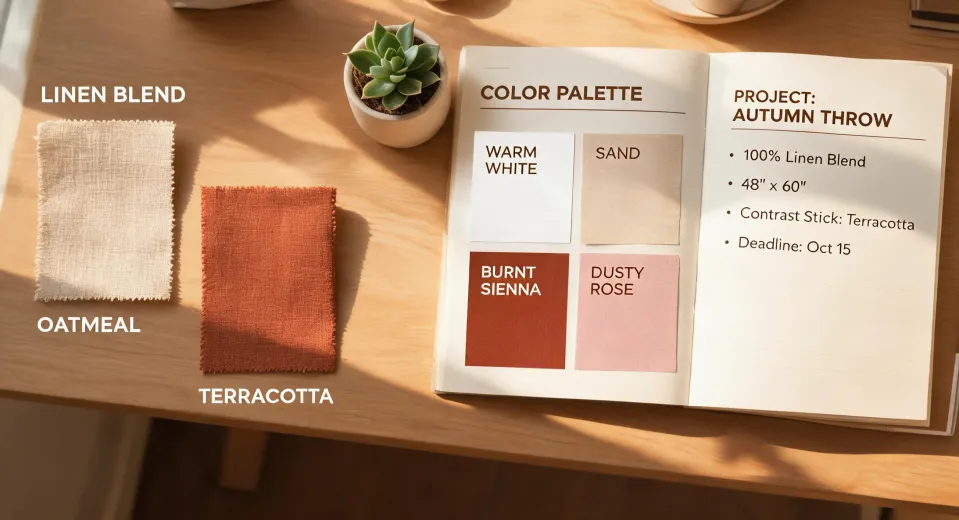
Digital swatches are a starting point, not a standard. Screens render color differently—and "close enough" on a monitor can be glaringly wrong in a real room with real lighting.
In 2024, I spec'd a fuchsia satin fabric for a boutique hotel's accent chairs. The online color card looked perfect. I ordered a physical sample before committing to 120 yards, and the swatch read noticeably more orange under natural light. Five days of waiting saved us from a project-wide redo.
So: every spec, every time, regardless of whether I've ordered the same fabric before, gets a physical sample. It's the cheapest insurance in the industry. (And if the vendor hesitates to send a sample? That tells you something, too.)
Step 4: Match Your Needle and Thread to the Fabric
This one's for anyone who actually cuts and sews—custom furniture makers, workrooms, in-house seamstresses. The right needle isn't a technical footnote. It's a quality-control decision.
On the question I get most often from our workroom: what size needle for satin fabric? In my experience, a 70/10 or 80/12 sharp/microtex needle is the sweet spot for most satin and tightly woven decorative fabrics. Satin is slippery and prone to snagging, and a needle that's too large will leave visible holes or cause puckering along the seams. Test on scraps before cutting into the real material—no exceptions.
Velvet is a different story. Depending on the pile height and backing, a ballpoint or even a leather needle may be the safer choice. Heavier upholstery fabrics—like Romo's twill or knit lines—often call for a 90/14 or 100/16 with heavy-duty thread. The point is: verify the spec before you cut, not after a panel is ruined. A 60-second swatch test is almost free; a ruined panel is not.
Step 5: Check Dye Lot and Batch Numbers
Here's a step I skipped in my early days, and it cost me. Fabric from different dye lots can vary subtly in shade. It's normal—and it's fatal if nobody checks before cutting.
Now I ask for dye lot numbers and make sure the full order comes from the same lot. If the volume exceeds what the lot has available, I either get client sign-off on the variation or reconsider the plan. I went back and forth on this once with a neutral Romo fabric—"it'll be fine" felt true in the moment. But with drapery and upholstery in the same room, a shade difference is exactly the kind of detail a client notices. We waited for the same lot and it was the right call.
Step 6: Add Waste Factor to Your Yardage
There's a difference between measured yardage and orderable yardage. Pattern repeats, skew, grain issues, shading—all of these eat into usable material. I add roughly 10–15% for directional patterns and velvets, and less for plains and knits.
In 2023, I placed an order where the pattern repeat consumed an extra 3.5 yards per panel. If I'd stuck to the exact measured number, the workroom would have run out, we'd have waited three weeks for a reorder, and the client would have rightly wondered what they were paying me for. The extra 15% cost us a little upfront and saved us a lot downstream. It's the kind of math that feels annoying until it saves you.
Step 7: Confirm Lead Times in Writing
Finally: get the lead time confirmed in writing before you place the order. Not after. This is the step I should have pushed back on earlier in my career.
When I started, I trusted "should be about two weeks" without asking for specifics. Those words came back to bite me when a hotel project was delayed by nine days because the fabric was backordered. Passed that lesson to a colleague recently: a written date is a commitment; a spoken estimate is a hope.
Now I verify three things before committing: is the fabric in stock? What's the ship date? What's the delivery window? And I build in a buffer—for us, three to five days—for logistics hiccups. In Q2 2024, when we consolidated orders for 400 employees across three locations, this step alone prevented two near-miss deadlines.
The Mistakes I Still See
Three things, in order of frequency:
- Ordering without a physical sample for "just an accent" pieces. Accents are exactly where color mismatch stands out.
- Using a dress-fabric needle on upholstery fabric. Upholstery weight can dull a needle mid-run and cause snagging. Verify needle and thread specs before you start.
- Trusting the screen over the swatch. Every monitor renders color differently. The fabric in your hand is the only true representation.
One more note: this checklist worked for us, but we're a small studio with predictable ordering patterns. If you're handling hospitality-scale projects, international sourcing, or dynamic pricing, your process will have more layers. But the principle holds: a few minutes of checking beats weeks of rework.