-
Step 1: Spec It Before You Price It
-
Step 2: Calculate Landed Cost, Not Unit Price
-
Step 3: Get a Physical Sample Before You Commit
-
Step 4: Test the Three Things That Actually Matter
-
Step 5: Audit Their Reorder Capability — Not Just Their First Order
-
Step 6: Account for Cutting Waste and Rework
-
Step 7: Lock Your Price and FX Terms
-
Common Mistakes and Final Notes
If you're sourcing decorative fabrics for a commercial project, a hotel refurbishment, or a bulk residential order, this checklist is for you. It assumes you don't have time for sales pitches — you just want a sequence of steps that gets you to a better decision.
I've managed fabric procurement budgets for about eight years. Decorative fabrics, wallcoverings, and drapery. Our annual spend runs between $200,000 and $400,000 on projects spanning boutique hotels, wellness centers, and high-end residential.
What follows is the exact seven-step framework I run every time we evaluate a new supplier or spec a project.
Step 1: Spec It Before You Price It
Most people do this backwards. They get a price sheet, compare unit costs, then scramble to figure out the specs afterward. That's the wrong order. A price only means something if the specs behind it are comparable.
Before you request a single quote, define these:
- End use — upholstery, drapery, cushion, or wallcovering
- Minimum Martindale abrasion (20k–30k for mid-traffic commercial, 40k+ for high-traffic)
- Colorfastness to light (reference BS EN ISO 105-B02, minimum grade 4–5)
- Composition tolerance — natural, synthetic, or blended
- Width requirements (standard 140cm vs. wide-width 280cm+)
One thing that trips people up on specs: satin woven fabric has a smooth, lustrous face but lower snag resistance because the weave structure floats longer yarns on the surface. Twill fabrics, on the other hand, are generally softer than plain weaves at the same weight — but fiber and finish matter far more than weave structure. I've handled coarse twills and silky poplins. Don't let the weave name do your thinking for you.
Skip this step and the other six fall apart.
Step 2: Calculate Landed Cost, Not Unit Price
Unit price is the least useful number on any quote. I mean that literally.
Last year I compared two suppliers for a drapery project. Supplier A quoted £18.50/m. Supplier B quoted £14.20/m. A 23% gap. On paper, B wins.
Then I built the comparison sheet:
- B charged £85 for a pre-production sample. A sent theirs free.
- B's minimum order was 60m vs. A's 30m — the extra 30m sat on a shelf and eventually got written off. That's £200.
- B shipped in 8 weeks. A shipped in 4. B would have missed our install window.
- B's pattern repeat was 64cm vs. A's 32cm — that added roughly 12% cutting waste, about £170 in extra fabric.
By the time I added it all up, B was £142 more expensive. The cheaper quote wasn't cheaper.
It's tempting to compare unit prices directly. But identical specs from different vendors can produce wildly different outcomes once shipping, duties, sample fees, MOQ penalties, cutting waste, and rework costs enter the picture.
Build a landed-cost line for every supplier. Include: freight, import duty, sampling, minimum-order surcharge, cutting waste, and return/redo exposure. Then compare.
Step 3: Get a Physical Sample Before You Commit
Screen color is a liar. Fabric has dimension — the way light hits a velvet at an angle is not the way it photographs.
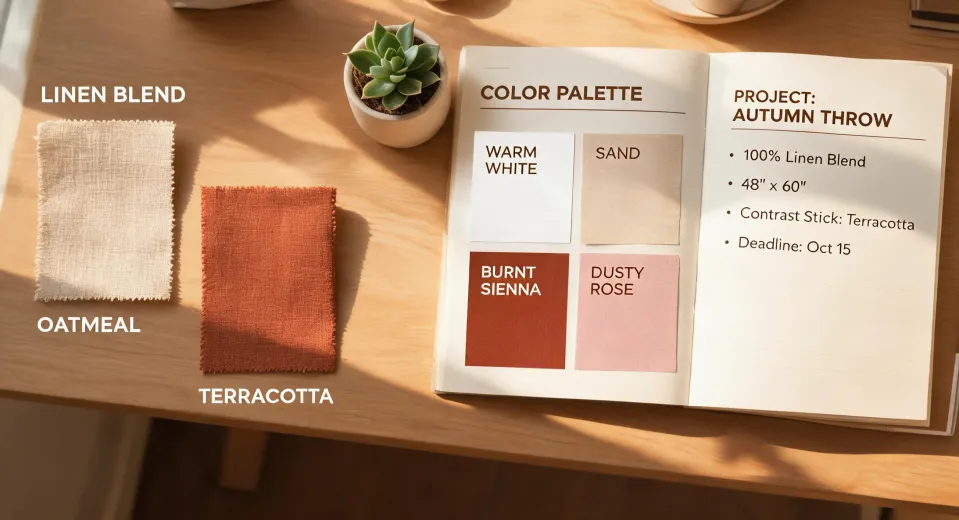
I learned this the hard way. In 2022, I ordered a cream upholstery fabric based on a supplier's digital swatch. What arrived was closer to oatmeal. Under our site's lighting, the whole thing turned grey. We couldn't return 400 meters. The fabric ended up on a different project with warm ambient lighting where it actually worked — but I got lucky.
Here's the communication trap: we both said 'standard cream.' We meant different things. The supplier referenced their color card code. I referenced what I pictured in my head. Two different languages wearing the same three words.
So: every order, every time — physical sample in hand. Check it under daylight and under the actual interior lighting. Lay it against the other materials in the space. Sign off on a physical reference swatch before production.
Step 4: Test the Three Things That Actually Matter
You don't need to run every test in the book. You need to test the three that can blow up your project.
For most upholstery and drapery projects, those three are:
- Martindale abrasion — if it fails, the whole installation fails
- Lightfastness — critical for any window-adjacent application
- Dimensional stability — will it shrink after cleaning or steaming?
Yes, your supplier provides test reports. But those reports test their lab swatch, not the roll you'll actually receive. Batch-to-batch variation is real. If the budget allows, request third-party testing on a sample pulled from your production batch. That's £150–250 for the test. Compare that to the cost of replacing 400 meters of ruined fabric after installation.
Easy call.
Step 5: Audit Their Reorder Capability — Not Just Their First Order
Most procurement managers spend all their energy on the initial order. But commercial projects ship in phases. You will need more fabric six weeks later. Possibly more after that.
Ask your supplier:
- What's the standard lead time for a repeat order?
- How much stock do you hold of this specific article?
- If stock runs out, what's the production lead time?
- What's your batch-to-batch color tolerance?
This is where established groups like Romo Group tend to hold an advantage. With showrooms and distribution across Europe and the UK, their replenishment pipeline is usually shorter than smaller mills. Their Linara range, for example, gets specified heavily in hospitality because designers know they can reorder six months later and get something close to the original shade.
But regardless of who you use — get reorder terms in writing. Verbal promises on replenishment timelines are worth nothing.
Step 6: Account for Cutting Waste and Rework
This is the step most people skip. Then they get the real invoice.
Cutting waste varies wildly by fabric type. A solid-color weave might lose 5–8% to cutting waste. A large-repeat pattern that requires alignment can lose 15–25%. That's a real cost difference on a 500-meter order.
My working estimate: usable yield runs about 85–90% for plain fabrics, 75–80% for large repeats. If a supplier tells you 'most of our customers only lose 5%,' ask what their customers are actually making. Probably not pattern-matched drapery panels.
Rework is worse. If a batch arrives with significant shading variation and you have to remake chair covers, the cost is typically 2–3x the original fabric price once you account for labor, disruption, and timeline impact.
Step 7: Lock Your Price and FX Terms
Last step. Easiest to forget. Expensive to overlook.
If you're importing from the Eurozone and billing in GBP, currency movement can eat your entire margin. Between January and June 2024, GBP/EUR moved roughly 3.5%. On a £500,000 project, that's £17,500 — gone. Not from anything anyone did wrong. Just from a term that wasn't negotiated.
At minimum, lock one of these into the contract:
- Fixed exchange rate at quote
- Price cap for staged deliveries
- Shared movement on FX beyond a defined threshold
Suppliers don't enjoy these conversations, but they dislike lost orders more. Ask.
Common Mistakes and Final Notes
After eight years and a few hundred orders, these are the patterns I see repeat:
- Quoting by unit price — landed cost is the only real number
- Ordering from screen swatches — color and hand can't be judged digitally
- Ignoring reorder cycles — commercial projects ship in phases
- Forgetting cutting waste — large-repeat patterns consume 15–25% more
- No FX clause — a silent budget killer on imported goods
One thing I want to be clear about: cheap isn't the problem. Not understanding your cost structure is the problem. Running these seven steps doesn't mean you'll always pick the most expensive option — it means you'll know what you're actually paying for. The phrase 'upholstery fabric UK cheap' isn't a useful search term. 'Lowest landed cost at Martindale 30k with 4-week reorder' is a useful question.
I'd rather spend ten minutes walking a designer or a junior buyer through the spec sheet than spend three months untangling a fabric delivery that never should have been ordered.